In Wrapbook:
Your worker classification is set per project by the production
Your worker type may differ from one project to another
If your worker classification is incorrect on a project, contact the project’s production administrators and ask them to update it
The classification of the worker determines how the worker is paid, how taxes are handled, what forms they receive, and which employment protections apply to them.
In Wrapbook, you may be classified by your employer as an Employee (W-2) or a Loan Out (Company). In limited cases, you may also be classified as a Contractor, depending on state law and production rules.
This guide explains what each classification means and how to confirm your worker type in Wrapbook.
Why your classification matters
Your worker classification affects:
Whether Wrapbook withholds taxes on your behalf
Whether you are covered under workers’ compensation
How your unemployment insurance is handled
Which tax forms you receive at the end of the year
Which onboarding information you’ll be asked to provide
Correct classification is required under U.S. employment law and state-specific rules (such as the ABC Test or Common Law Test) that set guidelines for determining whether a worker is an Employee or Independent Contractor.
Worker types in Wrapbook
Your worker classification is set per project by production and your worker type may differ from one project to another.
The summaries below explain how each worker type is paid, taxed, and which year‑end forms to expect.
Employee (W-2)
Most production workers are classified as W-2 Employees.
When you’re classified as an Employee:
Wrapbook becomes your Employer of Record for tax withholdings and unemployment insurance
Wrapbook withholds applicable federal, state, and local taxes
You are covered under Wrapbook’s workers’ compensation policy
Your earnings are taxed under your SSN
At year-end, you receive a W-2
Loan-Out (Company)
If you have a business entity that provides your services (often called a Loan-Out Company), you may be classified as a Loan-Out.
To be paid as a Loan-Out in Wrapbook, your company must:
Be incorporated as an S-Corp, C-Corp, or an LLC filing as an S-Corp or C-Corp
Have an active Employer Identification Number (EIN)
Provide complete tax and incorporation details during onboarding
Other business types are not eligible to be serviced as Loan-Outs.
When you’re classified as a Loan-Out:
You receive a 1099-NEC for payments made to your company
Wrapbook does not withhold payroll taxes
You, as the owner of the Loan-Out, are covered under Wrapbook’s workers’ compensation policy
You must provide full company tax information in your Wrapbook profile
Information you’ll be required to submit:
Company Legal Name
EIN
Federal Tax Classification
Business Address
Jurisdiction of Incorporation
Articles of Incorporation (production companies that use Wrapbook have the option to request this documentation )
If you’re a loan-out worker who’ll be working in California during the project, you can optionally enter your company’s CA Employer Account Number. If you don’t have a CA Employer Account Number, or you won’t be working in California, you can skip this field. Learn more about this option and related requirements on the California EDD website.
Payment methods for Loan-Out workers
Loan-Outs may be paid in one of two ways:
Time-based payment
Recommended in general, and required for unionized Loan-Out workers
You submit a timecard through Wrapbook
Your hours and rates are approved by production
Wrapbook issues payment to your Loan-Out entity
Invoice-based payment
You submit invoices instead of timecards
Production reviews and approves your invoice
Wrapbook issues payment to your Loan-Out entity
Contractor classification
Some workers may be hired as Independent Contractors, but this is rare in entertainment.
What to know about Contractor status:
Many jurisdictions apply one of several classification tests, most commonly:
ABC Test – a strict statutory test used in states such as CA, NJ, and MA
Common Law Test – a control-focused test used by the IRS and many states
Economic Realities Test – used by the U.S. Department of Labor for FLSA purposes
When you’re paid as a Contractor:
The production company is your Employer of Record (not Wrapbook)
No payroll taxes are withheld by Wrapbook or the production company
You receive a 1099-NEC from the production company
Contractors may elect to have backup withholding in Wrapbook. When this is elected, Wrapbook withholds 20% per the backup withholding rules.
What's the difference between a Contractor and a Loan Out?
Both Contractors and Loan Outs are used for individuals who are not being paid as employees — neither has payroll taxes withheld by Wrapbook. The key differences in Wrapbook are:
Loan Out: You have a qualifying business entity (S-Corp, C-Corp, or qualifying LLC), and payments are sent to that entity's EIN. You are covered under Wrapbook's workers' compensation policy.
Contractor: You are paid under your SSN or TIN as an individual. You are not covered under Wrapbook's workers' compensation policy.
Your production administrator sets your classification. If you believe you've been classified incorrectly,
before your next payment.
Can I be a Loan Out if I'm a sole proprietor or in a partnership?
No. To be classified as a Loan Out in Wrapbook, your business must be an S-Corp, C-Corp, or an LLC filing as an S-Corp or C-Corp. Sole proprietors, general partnerships, and other entity types are not eligible. If your business doesn't qualify, speak with your production administrator about being set up as an Employee or Contractor instead.
How to confirm your worker classification
You can view your worker type from your project’s Timecards dashboard in Wrapbook.
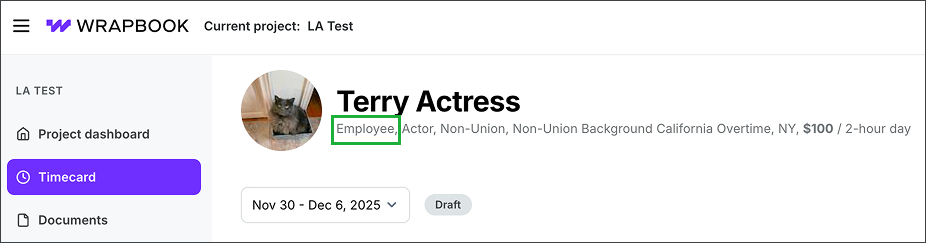
Your worker classification is listed on your project timecards
How to change your worker type in Wrapbook
In Wrapbook, worker classification is set per project by the production employer during onboarding. If your situation has changed or you were set up incorrectly:
Contact your production administrators and ask them to update your worker classification before the next payment
Future payments will follow the updated worker type
Past payroll and reporting remain as originally processed
Your worker classification FAQ
To help you understand your worker classification in Wrapbook, we’ve put together this list of frequently-asked questions.
What happens if my payment for work is sent to a different type of bank account?
Sometimes funds are sent to a different type of bank account for example:
Loan‑Out classified worker paid to a personal account
Employee classified worker paid to a business account
The good news is that your payroll and tax reporting will remain accurate even if the destination account type doesn’t match. In Wrapbook, reporting follows your worker classification and the payroll run, not the bank account type.
If funds are deposited into the wrong bank account, please transfer the money between your own accounts through your bank. Wrapbook Support cannot move funds between your accounts.
I’m union. Does that make me an Employee?
Union status doesn’t automatically define your worker classification. Classification is based on how the production onboarded you for the project.
Will I get both a W‑2 and a 1099 from the same production?
Possibly, if you were classified differently on different projects or for different engagements.
My pay stub doesn’t show withholdings. Is that wrong?
Not necessarily. and Loan‑Outs typically do not have Employee tax withholdings. Employees do.
Can I pick my worker classification?
Speak with your production administrators. Remember, workers must be classified in a way that aligns with company policy, jurisdictional rules, and your documentation.
I have a single-member LLC. Can I use it as my Loan-Out in Wrapbook?
A single-member LLC that has not elected to be taxed as an S-Corp or C-Corp is classified by the IRS as a disregarded entity — meaning it is not considered a separate tax entity from its individual owner. Because of this, Wrapbook is unable to process payments through a standard single-member LLC as a Loan-Out.
What worker classifications are available to me in Wrapbook?
If your LLC does not meet Loan-Out eligibility requirements, the worker classifications available in Wrapbook are:
Employee (W-2): You are onboarded as an individual. Wrapbook serves as the Employer of Record, withholds applicable payroll taxes, and covers you under workers' compensation. You receive a W-2 at year-end. All payments are tied to your personal SSN.
Contractor (where applicable): In limited cases, and subject to state law and the production's policies, you may be classified as an Independent Contractor. This classification is uncommon in the entertainment industry and must comply with applicable worker classification tests (such as the ABC Test or Common Law Test). The production company acts as Employer of Record for this classification.
Your classification is set by the production. Wrapbook does not determine which worker type is appropriate for your situation. If you have questions about how you should be classified, contact your production's administrators. For questions about your specific tax or legal situation, consult a tax professional or employment attorney.
What if I want to route payments through my LLC?
If you want Wrapbook to process payments through your LLC as a Loan-Out in the future, your LLC would need to formally elect corporate tax treatment with the IRS:
S-Corp election: File IRS Form 2553
C-Corp election: File IRS Form 8832
Once your election is approved and your LLC is confirmed to file as an S-Corp or C-Corp, it would be eligible to be set up as a Loan-Out in Wrapbook. Consult a tax advisor before making any changes to your tax elections.
Am I covered under workers' compensation as a Contractor?
No. Workers' compensation coverage in Wrapbook applies to Employees and Loan Out workers. If you are classified as a Contractor, you are not covered under Wrapbook's workers' compensation policy.
I have an LLC. Does that mean I should be a Loan Out?
Not necessarily. Only LLCs that file taxes as an S-Corp or C-Corp are eligible for Loan Out status in Wrapbook. If your LLC is taxed differently (for example, as a sole proprietor or partnership), you would not qualify as a Loan Out.
I've been paid as a 1099 contractor on other productions. Will that be the same in Wrapbook?
It depends on how your production has classified you. Classification is set by your employer, not by Wrapbook. Keep in mind that many states — particularly California — require that most on-set workers be classified as Employees, regardless of how they've been paid in the past.